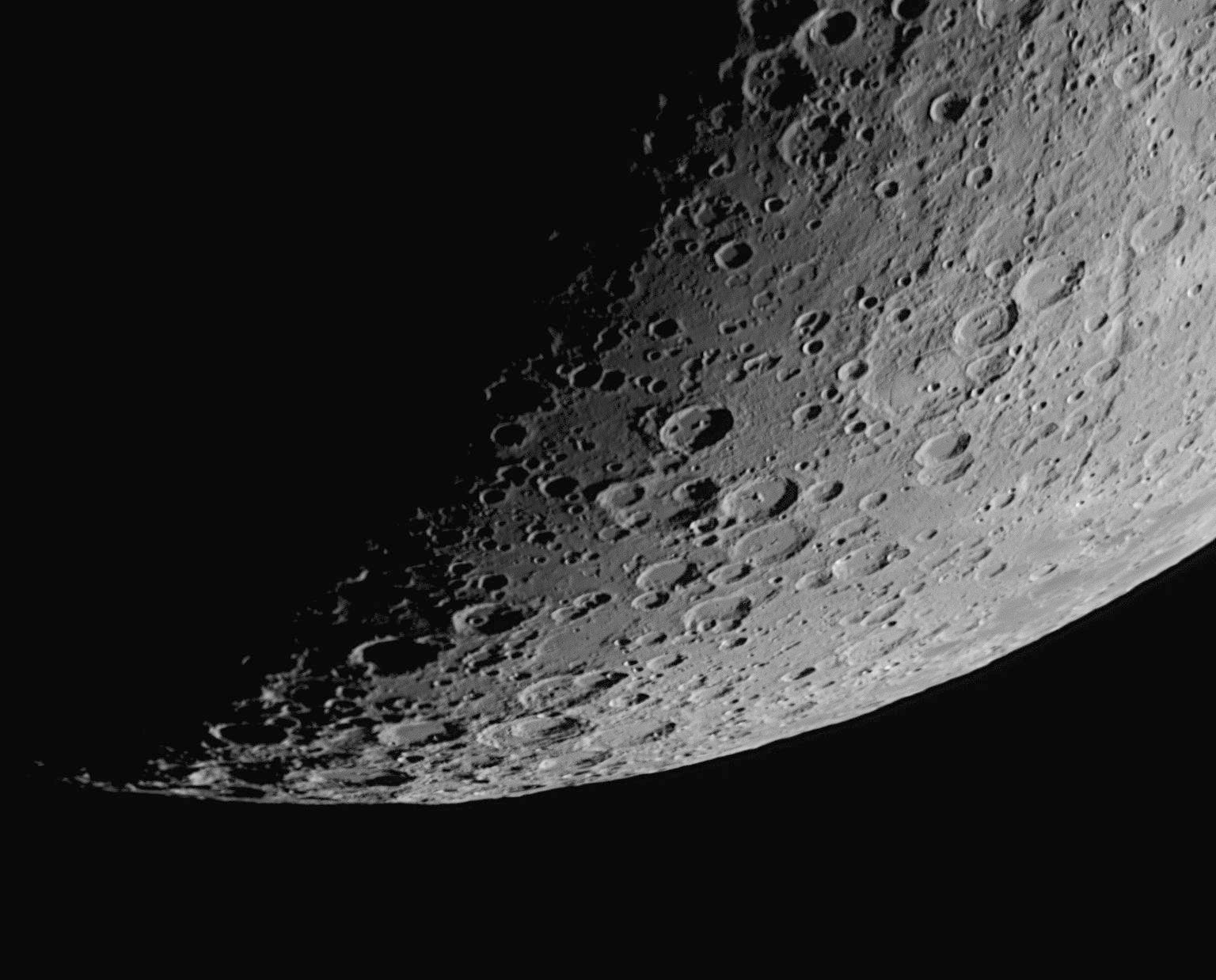
Day 5 view of the south-eastern sector of the Moon.
Details
- Rig: Player One Ares-M Pro + Tecnosky RC8 + EQ6R-Pro
- Software: NINA/Sharpcap v4.1/Autostakkert/Registax/GIMP
- Filters: Altair Astro Planet-Killer 685nm IR Pass
- Constellation: Aries
- Lucky imaging 10% of 500 frames
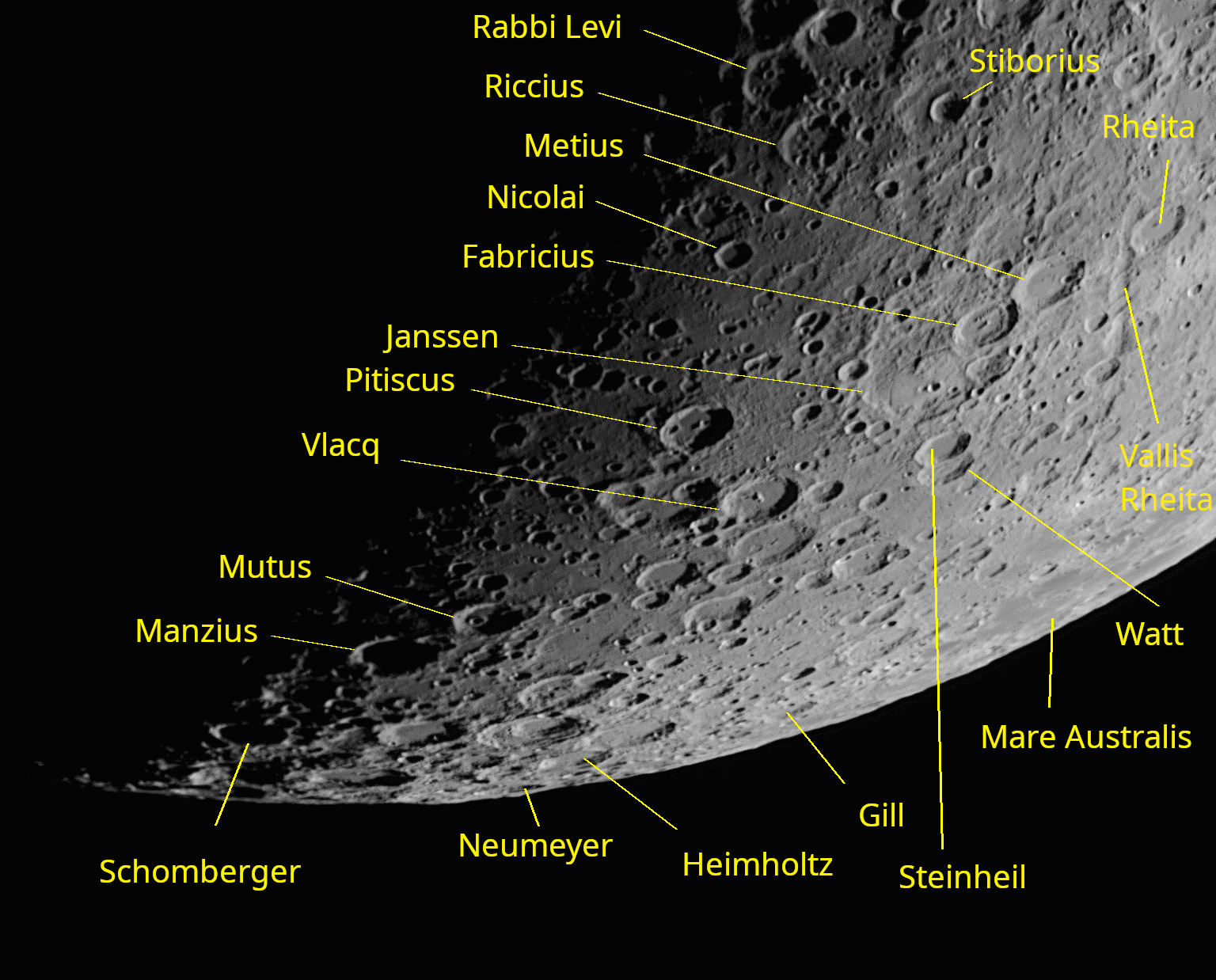
Annotated - click for larger view
Notes
First light for the newly-acquired Ritchey–Chrétien telescope. The sky was once more turbulent and difficult to handle and, consequently, focussing proved awkward even with the Sharpcap tools. I’m not convinced that perfect focus was achieved here. Nevertheless, the scope appears to perform well pending some more precise testing.
The focal length will be useful for the approaching galaxy season and, importantly, at F8 plate solving with ASTAP works well in comparison with the F12 classical cassegrain which constantly failed to resolve sufficient stars to allow correct identification of objects.
Some of the craters near the limb are difficult to identify but by using the Duplex Moon Atlas (R.Stoyan) it is possible. Interesting features are:
- Vallis Rheita - running south from the crater Rheita for 445 km. It is between 30km and 10km wide and is the second longest valley on the near side of the Moon.
- The long ridge running south between Stiborius and Rheita which has no explicit label or reference in Stoyan.
- The Mare Australis on the extreme south-eastern limb.
- The crater Riccius with a large number of internal craters.
- The rille system named the Rimae Janssen running in a curve from the rim of Fabricius for 140 kilometers.
- The huge crater Janssen (201km in diameter) with its 17 named satellite craters.